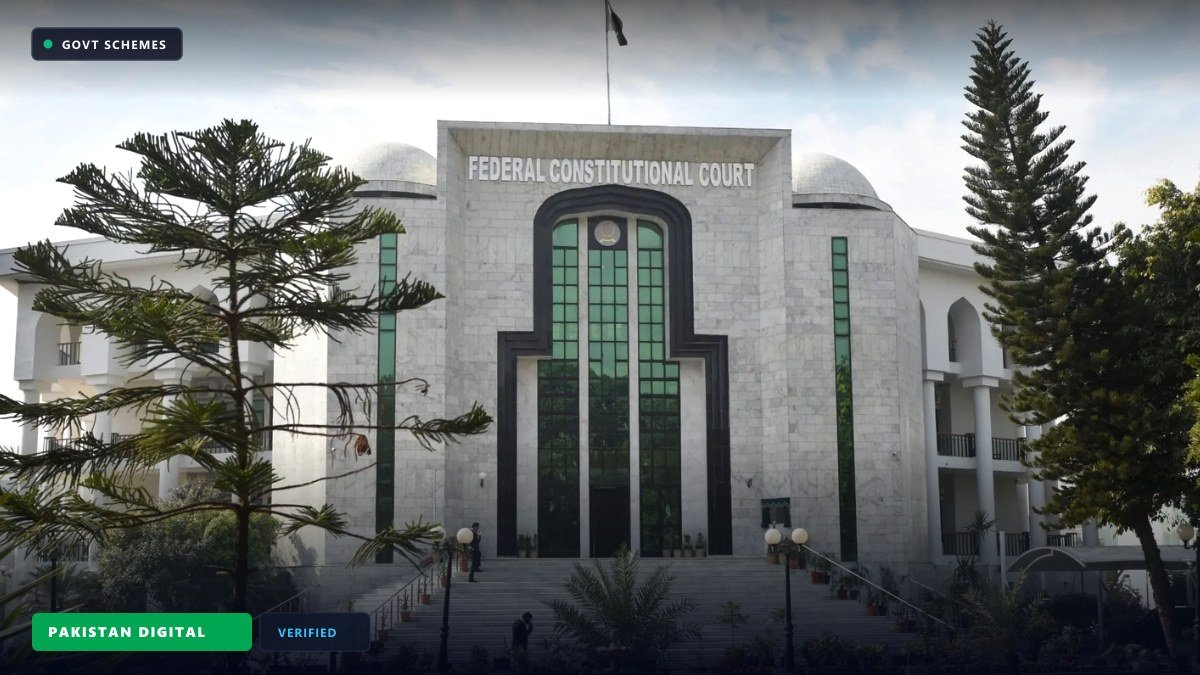
The Federal Constitutional Court has ruled that inheritance records cannot deprive anyone of their rightful share under Islamic law, clarifying that cousins may be entitled to the remaining property under certain conditions.
In an 11-page judgment authored by Chief Justice Aminuddin Khan, the court upheld the Lahore High Court's decision and dismissed appeals filed in a property inheritance dispute.
The court observed that inheritance rights cannot be determined solely on the basis of family ties or blood relationships. Instead, property must be distributed according to Islamic inheritance law and its established legal categories.
It ruled that after the prescribed shares are distributed among the widow and sisters, the remaining property belongs to eligible residuary heirs, known as Asabah.
The court further clarified that the principle of Radd, which allows the redistribution of remaining property among eligible heirs, cannot be applied when a legally entitled residuary heir exists.
In the case concerning the estate of Muhammad Asghar, the court upheld the inheritance claim of his paternal cousin, ruling that he was entitled to the remaining share of the property.
The judgment also emphasized that revenue records and procedural formalities cannot change an individual's inheritance rights or validate an unlawful distribution of property.
The two-member bench, comprising Chief Justice Aminuddin Khan and Justice Ali Baqar Najafi, upheld the Lahore High Court's November 6, 2024, decision while dismissing appeals filed by Kaneez Haider.
According to the ruling, Asghar's widow is entitled to one-fourth of his estate, while his two full sisters are collectively entitled to two-thirds. The remaining one-twelfth share will go to an eligible residuary heir.
The court also noted that inheritance laws differ between Sunni and Shia schools of thought, emphasizing that property must be distributed according to the Muslim personal law applicable to the deceased.
The bench concluded that the appellant had failed to establish any legal error that would justify interference with the Lahore High Court's decision.
The legal and procedural framework governing this matter underscores the critical importance of constitutional due process, judicial impartiality, and statutory compliance within Pakistan's judicial ecosystem.
Superior courts and competent adjudicating forums have continually held that administrative actions and prosecutorial requests must conform strictly to recognized standards of evidence, fair trial safeguards, and human rights benchmarks.
Legal practitioners and constitutional scholars point out that institutional adherence to statutory parameters remains essential to maintaining public confidence in the judicial process.
In addition to the immediate merits of the proceedings, judicial authorities emphasize that procedural integrity and transparent hearings are vital for safeguarding institutional decorum.
Relevant oversight bodies, bar associations, and statutory ombudsmen maintain rigorous vigilance over regulatory processes to guarantee that statutory safeguards are observed without arbitrary deviation.
Transparent judicial functioning is recognized by constitutional authorities as the bedrock of legal certainty and equitable public administration.
Legal analysts and senior advocates recommend that stakeholders and affected parties closely follow official court circulars, authenticated judicial transcripts, and certified case listings released through official registry desks.
Citizens and interested observers are advised against relying on unverified claims or circulating speculation on digital platforms, and are urged to verify case progress through official departmental bulletins and accredited legal counsel.