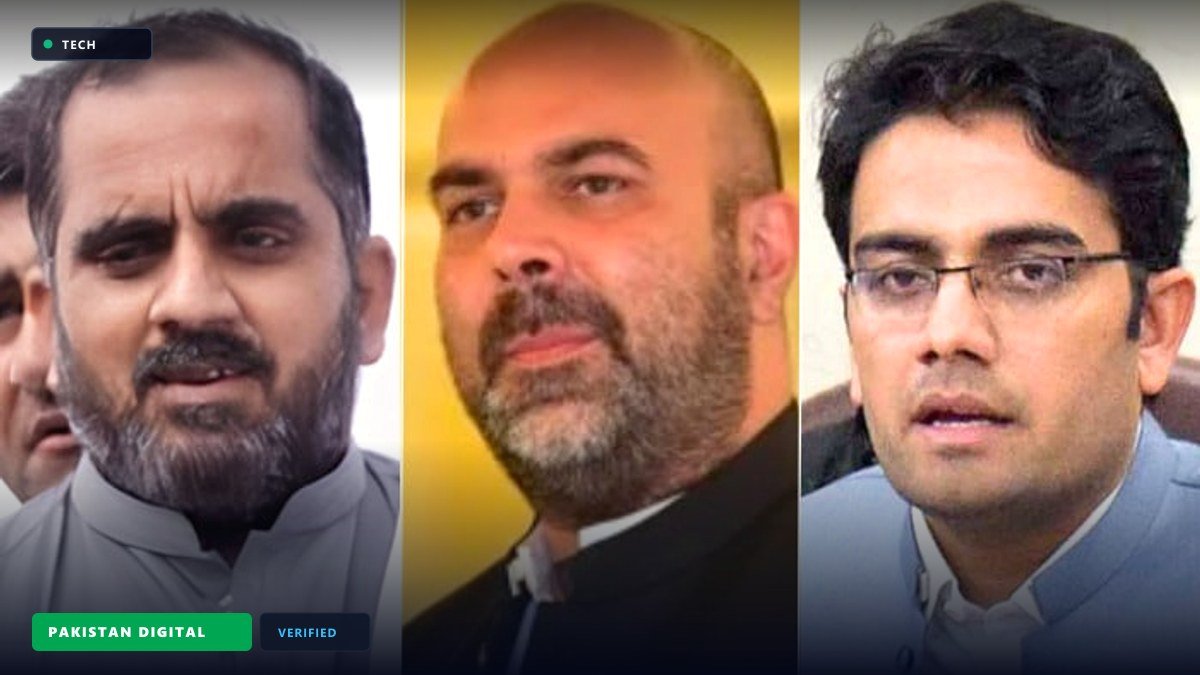
Arrests made after ATC rejected their bail pleas. : Leaders approached high court seeking interim bail. : PHC previously approved applications for interim bail.
: PESHAWAR: Police on Tuesday arrested three Pakistan Tehreek-e-Insaf (PTI) leaders, Taimur Saleem Jhagra and Kamran Bangash, along with Irfan Saleem, in the Radio Pakistan attack case.
The former ministers were taken into custody outside the Peshawar High Court (PHC).
According to police, Superintendent of Police (SSP) Operations Farhan Khan was present at the high court's main entrance with a contingent when the arrests were made.
They said that three leaders had reached the high court to seek interim bail after an anti-terrorism court dismissed their bail applications in the Radio Pakistan attack case.
They were present in the high court's bar room before being taken into custody. The PHC had earlier approved their applications for interim bail.
It may be noted that the Punjab Forensic Science Laboratory report, sought by an ATC in the Radio Pakistan attack case, earlier this year confirmed the presence of several PTI leaders, including Saleem, in footage relating to the May 9, 2023 incidents.
The laboratory examined 16 videos provided on a USB device at the request of Peshawar police. Its analysis found similarities between the leaders' profile photographs and individuals appearing in the footage.
The report also identified evidence of clip splicing in two videos linked to dysfunctional Khyber Pakhtunkhwa Chief Minister Sohail Afridi and Irfan Saleem.
The forensic examination was conducted between December 19 and 23, 2025, and was restricted to visual evidence.
The case Violent protesters, including workers and supporters of Pakistan Tehreek-e-Insaf (PTI), launched an attack on the historic structure after party's chairman Imran Khan was arrested on May 9 by Punjab Rangers to comply with the National Accountability Bureau (NAB) arrest warrant in the Al-Qadir Trust case.
Khan's arrest infuriated party activists who took to the streets in several cities across the country, damaging public and private property, including military installations.
Peshawar was also one of the cities where supporters of PTI unleashed havoc. In the city, protesters stormed the historic Radio Pakistan building and went on a vandalising rampage that culminated in setting the building ablaze.
Angry protesters not only set fire to the historic building, but also plundered it. The charred interior of the building shows extensive damage as the arson followed vandalism and looting.
The resulting inferno consumed irreplaceable records and other invaluable items, resulting in significant losses.
The legal and procedural framework governing this matter underscores the critical importance of constitutional due process, judicial impartiality, and statutory compliance within Pakistan's judicial ecosystem.
Superior courts and competent adjudicating forums have continually held that administrative actions and prosecutorial requests must conform strictly to recognized standards of evidence, fair trial safeguards, and human rights benchmarks.
Legal practitioners and constitutional scholars point out that institutional adherence to statutory parameters remains essential to maintaining public confidence in the judicial process.
In addition to the immediate merits of the proceedings, judicial authorities emphasize that procedural integrity and transparent hearings are vital for safeguarding institutional decorum.
Relevant oversight bodies, bar associations, and statutory ombudsmen maintain rigorous vigilance over regulatory processes to guarantee that statutory safeguards are observed without arbitrary deviation.
Transparent judicial functioning is recognized by constitutional authorities as the bedrock of legal certainty and equitable public administration.
Legal analysts and senior advocates recommend that stakeholders and affected parties closely follow official court circulars, authenticated judicial transcripts, and certified case listings released through official registry desks.
Citizens and interested observers are advised against relying on unverified claims or circulating speculation on digital platforms, and are urged to verify case progress through official departmental bulletins and accredited legal counsel.