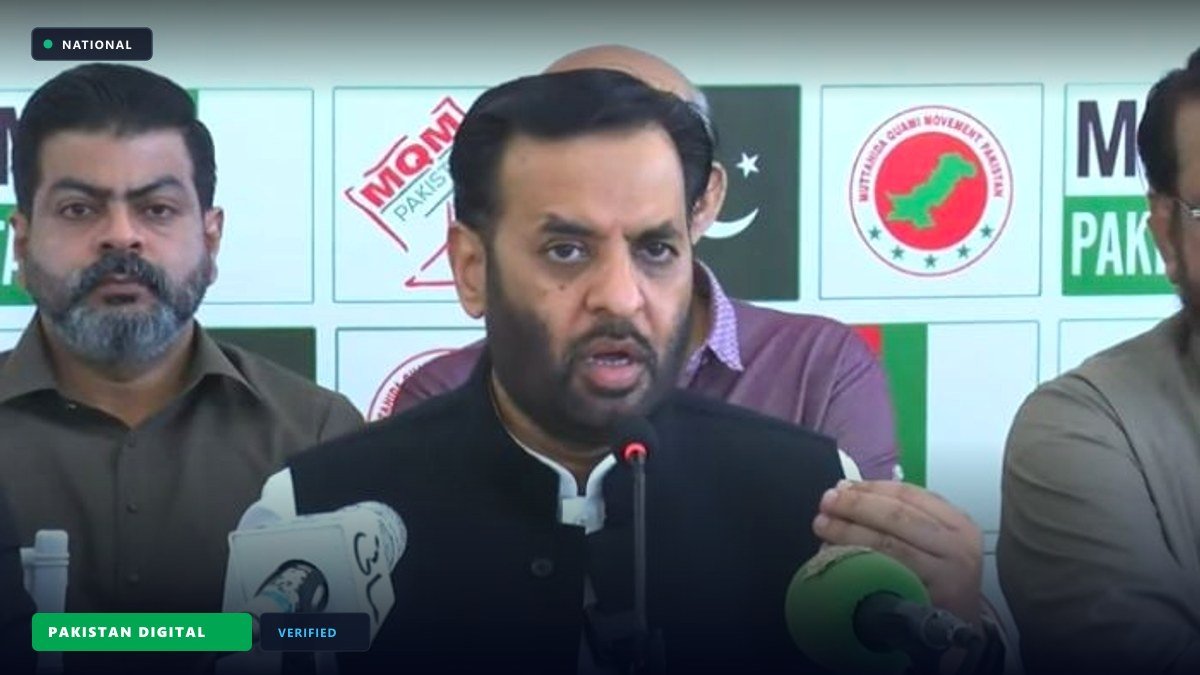
Kamal says referendum will determine future provincial setup. : Calls December a crucial month for proposed changes. : Accuses political forces of fuelling ethnic divisions in Sindh.
: KARACHI/ISLAMABAD: Muttahida Qaumi Movement-Pakistan (MQM-P) leader Mustafa Kamal has said a referendum will be held on the creation of new provinces, describing December as a crucial month for the proposed move.
Addressing party office-bearers and workers in Karachi’s District Central, Federal Health Minister Kamal said Pakistan was standing at a decisive historical juncture and that “dreams of the past are now turning into reality”.
He alleged that opponents of new provinces wanted to pit the city’s and province’s linguistic communities against one another. Kamal said the time had come to end the feudal, landlord and capitalist systems in the country.
He also claimed that the Pakistan Peoples Party (PPP) did not represent the entirety of Sindh and that Sindhi nationalists were enemies of the Sindhi people.
Islamabad’s administrative status may be changed Meanwhile, government sources say preparations are complete to grant Islamabad a special administrative status, with a new governance model proposed for the federal capital.
Under the proposal, Islamabad could be made a special-status territory or a model administrative unit, with a mayor serving as its administrative head. The elected body of the proposed unit could comprise 25 to 30 members.
The sources said the plan also envisaged expanding Islamabad’s geographical boundaries.
Proposals under consideration include incorporating parts of Haripur district in Khyber Pakhtunkhwa, some areas of Rawalpindi and parts of NA-51 in Murree into the federal capital.
However, a proposal to include Gwadar or other ports in Islamabad’s administrative structure has reportedly been dropped.
Debate over new provinces The remarks come amid a renewed debate over the creation of new provinces, with Interior Minister Mohsin Naqvi recently describing a referendum as the “best solution” to the issue.
Naqvi said public opinion should determine whether new provinces should be created, adding that all political parties, including the PPP and Pakistan Muslim League-Nawaz (PML-N), needed to be taken on board.
Defence Minister Khawaja Asif has also backed the creation of new provinces on administrative grounds, saying even 12 could be considered.
The discussion follows reports that a proposal to reorganise Pakistan into 12 provinces is under consideration, with Punjab potentially divided into four provinces, while Khyber Pakhtunkhwa and Balochistan could each have three and Sindh two.
However, no final decision has been taken on the proposed boundaries, administrative structures or constitutional process.
Public policy specialists and governance analysts view structured administrative initiatives as critical building blocks for institutional efficiency, social equity, and public welfare across Pakistan.
Coordinating policy execution across federal divisions, provincial secretariats, and local directorates ensures that state directives achieve tangible community benefits while maintaining strict operational transparency and budgetary accountability.
Administrative oversight bodies and public monitoring departments are actively deploying digitized service desks and computerized verification systems to streamline public service delivery.
By removing procedural bottlenecks and integrating transparent verification mechanisms, public institutions are working to ensure that civic facilities, developmental benefits, and state safeguards are accessible to all citizens without unnecessary bureaucratic hurdles.
Citizens and civic stakeholders are encouraged to rely on verified government gazettes, certified departmental web portals, and official facilitation counters for authoritative information.
Administrative directorates emphasize that public inquiries, official feedback, and grievance redressals can be registered directly through official departmental helplines and established public service portals.