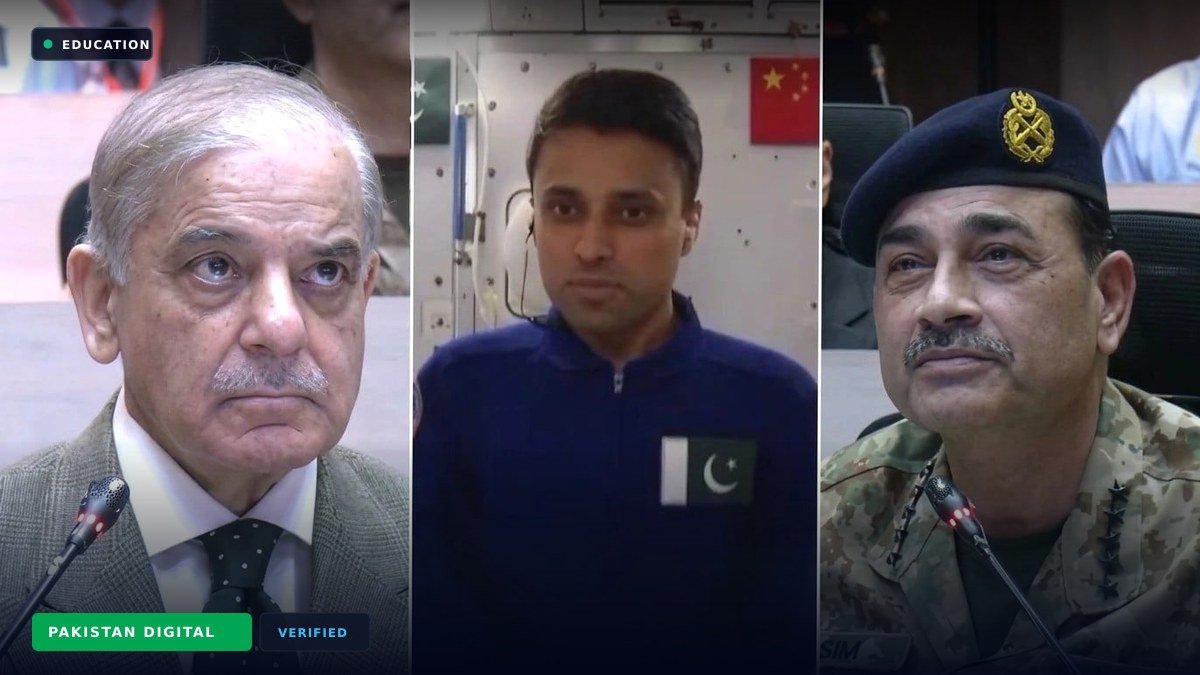
ISLAMABAD: Prime Minister Shehbaz Sharif and Chief of Defence Forces (CDF) Field Marshal Syed Asim Munir held a live video call on Saturday with Pakistani astronaut Muhammad Zeeshan Ali aboard China’s Tiangong space station, congratulating him on his historic achievement.
The premier and the CDF spoke with Zeeshan from the headquarters of the Space and Upper Atmosphere Research Commission (Suparco).
The prime minister described the occasion as a moment of pride for Pakistan’s 240 million people and congratulated Zeeshan Ali’s family and colleagues on the achievement.
“We are proud of young people whose ambitions soar beyond the stars,” PM Shehbaz said, while also paying tribute to the experts who assisted in the astronaut’s training and preparation.
Field Marshal Munir also spoke directly with Zeeshan Ali, saying the entire nation was proud of his achievement. He added that the armed forces, too, took pride in the historic milestone.
“Pakistan’s son has reached space and achieved this great feat,” the chief of defence forces said.
Highlighting the close ties between Pakistan and China, CDF Munir described their friendship as unparalleled, saying it is “higher than the Himalayas, deeper than the oceans and sweeter than honey”.
He said the friendship between the two countries have now reached the vastness of the universe.
A proud new chapter in Pakistan's history unfolded on Wednesday as Shenzhou-24 spacecraft, carrying the country's first astronaut, docked with the Tiangong space station after a three-and-a-half-hour-long journey from Earth, according to the China Manned Space Agency (CMSA).
Chinese state media reported that Shenzhou-24 astronauts, China's Tang Hongbo and Wu Yi and Zeeshan Ali, entered the Tiangong space station where they were welcomed by Shenzhou-23 crew.
The Shenzhou-24 space flight docked at Tiangong at 11:56am (8:56am Pakistan Standard Time) on Wednesday, roughly 3-1/2 hours after it took off from the Jiuquan Satellite Launch Centre in northwest China using a Long March-2F rocket.
The Long March 2-F rocket took off in a cloud of flames and smoke at 5:18am (PST) from the Jiuquan launch centre in China's northwestern Gobi Desert under a pink sky, video from state broadcaster CCTV showed.
The spacecraft successfully separated from the carrier rocket roughly 10 minutes after blast-off and entered orbit, the CMSA said. The launch was a "complete success", the agency said, adding that the crew was in good condition.
Ali is the first Pakistani to travel beyond Earth and the first foreign astronaut to visit China's Tiangong space station, placing Pakistan among the countries taking part in human spaceflight and opening fresh avenues for scientific collaboration with Beijing.
He is travelling as a payload specialist in a three-member crew alongside Chinese astronauts Tang Hongbo, who is commanding the mission, and Wu Yi, the flight engineer.
Academic policymakers and educational leaders recognize that continuous curricular modernization and institutional reform are essential to preparing students for the evolving demands of a globalized knowledge economy.
Educational directorates and higher education boards are actively aligning examination methodologies with conceptual learning standards, digital learning management systems, and analytical competencies.
These educational initiatives aim to elevate academic excellence while ensuring equitable learning opportunities for students across all socio-economic backgrounds.
In addition to instructional updates, educational institutions are emphasizing the expansion of research facilities, merit-based scholarship programs, and teacher development seminars.
Close collaboration between academic councils, industry partners, and provincial education ministries ensures that institutional programs equip graduates with practical skills, technological literacy, and ethical leadership capabilities necessary for national development.
Students, parents, and academic administrators are advised to verify all notifications, examination dates, and syllabus guidelines through official board websites and certified academic portals.
Education authorities caution against unofficial digital circulars, urging stakeholders to rely strictly on accredited institutional circulars and authorized institutional helplines.