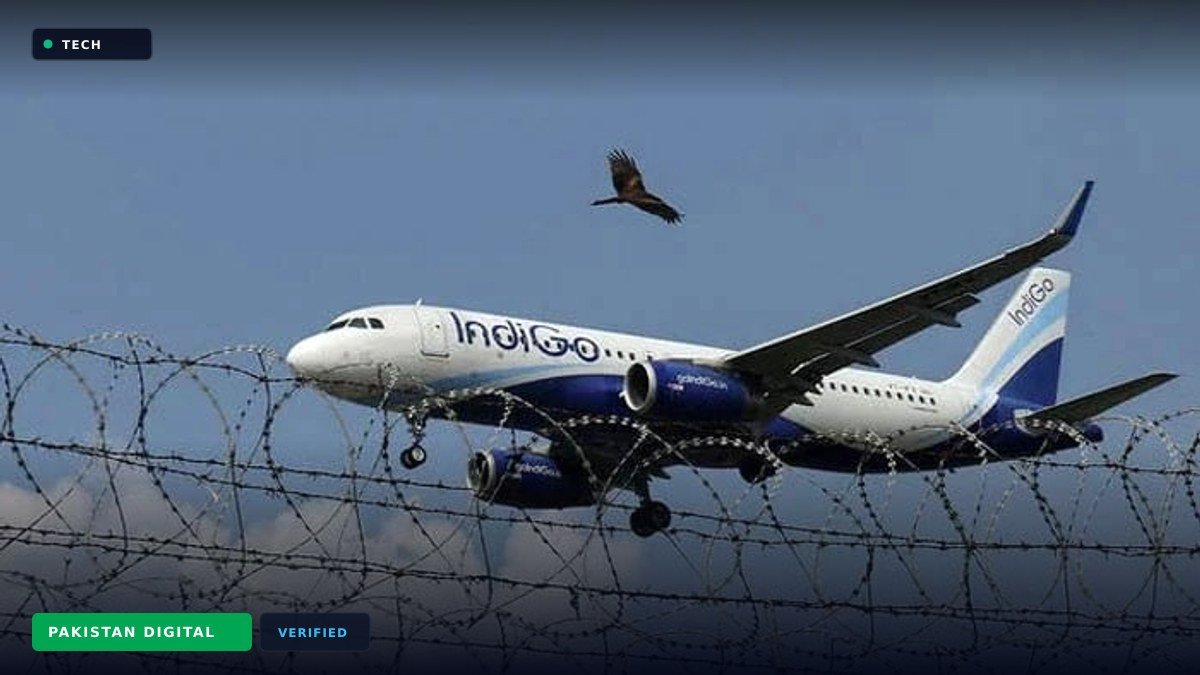
Indian-registered commercial, military planes remain barred. : Pakistan first closed its airspace to Indian aircraft in April 2025. : Restriction follows heightened tensions after Pahalgam attack.
: KARACHI: Pakistan has extended its ban on Indian aircraft using its airspace till December 24, according to a Notice to Airmen (Notam) issued by the Pakistan Airports Authority (PAA) on Thursday.
The restriction, first imposed on April 23, 2025, will now remain in place until 04:59 on December 24, 2026, read the Notam.
According to the authority, all Indian-registered commercial, jet passenger and military aircraft are not permitted to use Pakistani airspace.
Pakistan closed its airspace to Indian aircraft amid heightened tensions between the two neighbouring countries following the Pahalgam attack in Indian Illegally Occupied Jammu and Kashmir (IIOJK) and the subsequent diplomatic and military escalation.
India accused Pakistan of involvement in the attack, an allegation Islamabad has firmly denied while calling for an independent and transparent investigation.
In response to Pakistan's decision, India closed its airspace to Pakistani airlines on April 30, 2025. Tensions escalated further when India launched strikes on several Pakistani cities on May 6 and 7, 2025.
Pakistan responded with Operation Bunyanum Marsoos, targeting multiple Indian military installations in a large-scale retaliatory operation.
During the confrontation, Pakistan said it had shot down eight Indian fighter aircraft, including three Rafale jets, along with dozens of drones.
The hostilities lasted nearly 87 hours before the two nuclear-armed neighbours agreed to a US-brokered ceasefire on May 10, 2025.
The airspace restrictions had a greater financial impact on India's aviation sector, while Pakistan's aviation industry experienced comparatively limited disruption.
Pakistan imposed similar airspace restrictions in the past, including during the 1999 Kargil conflict and the 2019 Pulwama crisis. These episodes also caused greater operational challenges for Indian airlines than for Pakistani carriers.
From a broader technological perspective, this development highlights the accelerated pace of digital innovation and architectural evolution across both local and international tech ecosystems.
As advanced digital platforms, smart hardware, and intelligent software interfaces become increasingly woven into personal and enterprise workflows, questions of system security, algorithmic transparency, and cross-platform compatibility have assumed center stage.
Industry analysts note that contemporary software and hardware design demands robust engineering pipelines capable of adapting to stringent regulatory requirements and high user expectations.
Within Pakistan's expanding technology landscape, domestic developers, IT professionals, and digital consumers are closely monitoring how next-generation innovations influence everyday usability and digital productivity.
The Ministry of Information Technology alongside private software trade federations continues to emphasize the adoption of international data protection standards, robust cyber defense postures, and reliable consumer privacy practices.
By prioritizing structured engineering, continuous security audits, and user-centric designs, tech innovators are establishing sustainable foundations for long-term digital growth.
Industry observers and enterprise specialists advise consumers and technology professionals to stay informed through certified developer documentation, authentic firmware releases, and official security advisories.
Technology users are encouraged to maintain active security hygiene, perform regular software upgrades through accredited distribution channels, and follow verified product updates to maximize performance and security.