Live
Bitcoin (BTC)Rs. 18,650,000 +1.2%
Ethereum (ETH)Rs. 995,000 +0.8%
USDT/PKRRs. 282.50 +0.1%
Gold (24K)Rs. 455,300 +1.2%
USD/PKRRs. 278.40 -0.1%
PetrolRs. 373.78 -1.5%
BREAKINGGold (24K): Rs. 455,300 (+1.2%)
BREAKINGPetrol: Rs. 373.78 (Current)
BREAKINGKSE-100 Index: 74,250 (+0.4%)
BREAKINGPCB: Champions Trophy 2025 Schedule to be finalized next week
BREAKINGPunjab Announces New Fines for 26 Traffic Violations
BREAKINGPakistan Raises $250 Million Through First-Ever Panda Bond in Chinese Market
Business Fact Check: Verified

KSE-100 Index Gains 400 Points in Early Trade

E
Editorial Staff
| May 17, 2026|5 min read
KSE-100 Index Gains 400 Points in Early Trade
Business Feature • May 2026

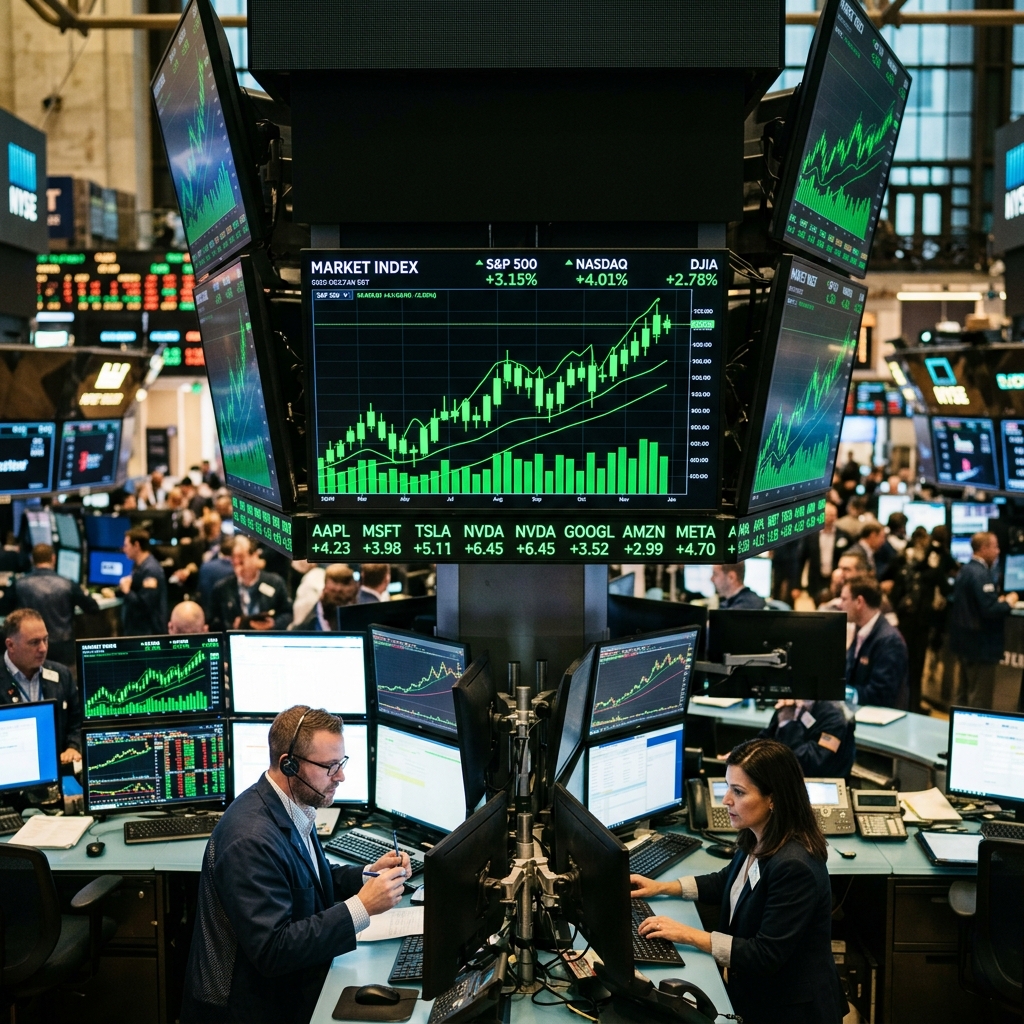
Representative image for the breaking development in Business sector. (Pakistan Digital Editorial)

Key Highlights

  • 1
    The benchmark KSE-100 index crossed the 74,500 mark during early trading.
  • 2
    Market volume remained strong with active participation in cement and tech sectors.
  • 3
    Positive sentiments surrounding IMF negotiations continue to boost investor confidence.

The benchmark KSE-100 index at the Pakistan Stock Exchange (PSX) closed at 74,250, showcasing a positive momentum in the latest session. Market data indicates a change of +0.4% (increase) as institutional buying and positive macroeconomic indicators fueled investor confidence across major sectors. Trading volumes were active as institutional players reshaped portfolios in response to stabilizing inflation figures and external financing inflows. Major brokerage houses noted that the market sentiment is improving on the back of expected fiscal discipline and policy continuations. This positive traction represents a strong rebound from previous quarters of low liquidity, static trading volumes, and range-bound movements, which had historically sidelined major local asset management companies and forced retail participants to keep their cash in conventional banking channels. The KSE-30 and All-Share indexes also showed corresponding gains, reflecting broader market participation. The exploration and production (E&P) sector led the charge with high-volume buying in oil and gas heavyweights.

Key market drivers include the ongoing structural reforms, successful talks with multilateral lending agencies, and stabilizing inflation metrics. Heavy trading volumes were observed in commercial banks, cement manufacturers, oil and gas exploration companies, and technology sectors. Local brokerage houses reported that institutional investors and foreign participants are gradually rebuilding positions, indicating long-term trust in the market's recovery path. Improved macroeconomic indicators, such as stable export data, growing IT services exports, and controlled current account deficits, have further strengthened the market's fundamental foundation. Additionally, regular sovereign debt repayments without defaults have anchored investor trust, pushing equity valuations closer to their historic averages. The steady flow of foreign remittances has also supported market liquidity. Brokerage firms in Karachi note that international funds are showing renewed interest in Pakistani equities due to attractive price-to-earnings ratios.

Listed companies reporting strong quarterly profits and announcing attractive payouts have also triggered retail interest, drawing domestic capital back to equities. Many retail participants are shifting their savings from commercial bank deposits into high-yield stocks, viewing the bourse as a viable hedge against persistent consumer inflation. Furthermore, easing import restrictions has boosted production capacities for industrial companies, reflecting positively on their stock prices. Power generation, commercial banking, and chemical sectors emerged as the volume leaders in recent trading sessions, showing robust liquidity flows. High-performing stocks like Pakistan Petroleum Limited (PPL), Oil and Gas Development Company (OGDC), Fauji Fertilizer Company (FFC), and Lucky Cement (LUCK) witnessed substantial turnover. These sectors are expected to maintain their leadership as local energy demands and manufacturing outputs pick up in the primary industrial zones. Easing refinery margins have also supported the auto and petrochemical assemblies.

Despite the bullish run, economists warn that maintaining this momentum requires policy consistency and political stability. The fiscal budget and changes in corporate tax structures are critical events that investors are monitoring. A stable exchange rate and regular inflows of foreign remittances have further bolstered the country's foreign exchange reserves, providing a buffer against external payment pressures. Any political noise or delay in structural loan reviews could cause temporary corrections on the stock market index, making it crucial for the government to maintain its reform momentum. A proactive communication policy from the finance ministry is key to managing local market expectations, avoiding speculation, and maintaining stability. Retail traders are advised to stay clear of speculative rumors and focus on companies with solid dividend histories. SECP compliance checks have also been tightened to ensure market transparency.

From an institutional perspective, the participation of local insurance companies and pension funds has provided a steady bid in the market. Foreign institutional flows have also turned positive after a prolonged period of selling, which is a major validation of the structural reforms implemented over the last year. Analysts suggest that the current valuations of blue-chip stocks remain cheap compared to regional peers, which could attract further international interest if the macroeconomic indicators remain on the recovery path. This institutional backing ensures that the index has a support floor during minor global commodity downturns, protecting the market from panic selling. The Central Depository Company (CDC) and National Clearing Company of Pakistan (NCCPL) have reported smooth trade settlements, highlighting the technical robustness of the market infrastructure. Moreover, the Securities and Exchange Commission of Pakistan (SECP) has continued to refine corporate governance and compliance regulations, making it easier for new companies to list on the PSX. This corporate framework, combined with automated circuit breakers that prevent extreme drops, helps build a safe investment ecosystem for retail participants who are new to stock market dynamics. New mutual fund listings are also expanding investment access.

Analysts suggest that if the government continues its reform agenda and manages external debt obligations effectively, the KSE-100 index will target new psychological resistance levels. However, experts also warn investors to remain cautious of global interest rate movements and commodity price spikes, which could introduce short-term volatility to the bourse. Diversifying portfolios across defensive and growth sectors is recommended for retail participants. Retail buyers are encouraged to rely on professional brokerage reports rather than rumors to execute trades in volatile sessions. Professional consultation helps retail portfolios avoid unnecessary stop-loss triggers, manage exposure limits, and build long-term wealth, while tax filing compliance helps optimize dividend returns under current capital gains tax (CGT) laws. It is also crucial to diversify holdings across at least three to four sectors rather than concentrating entire capital on a single speculative stock, reducing exposure to industry-specific regulatory shocks. Continuous monitoring of corporate balance sheets is highly advised for seasoned equity managers.

Pakistan Digital

© 2026 Pakistan Digital (Pvt) Limited. All rights reserved. Registered in Islamabad. Pakistan's most trusted independent editorial news engine.