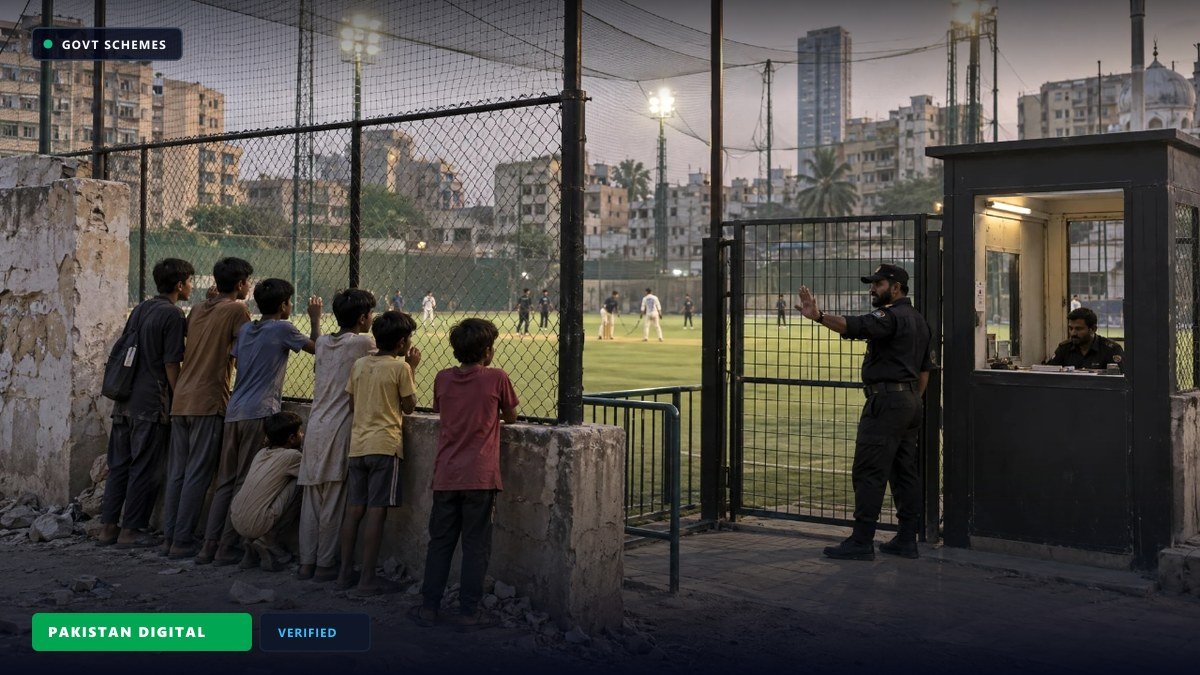
The growing commercialisation of public grounds by the Karachi Metropolitan Corporation (KMC) and Town Municipal Corporations (TMCs) has raised concerns about the affordability and accessibility of recreational spaces, particularly for children and young people from low-income households.
In one Korangi locality alone, four Playgrounds sit within a radius of roughly one kilometer, yet local children have limited access to them because the facilities have been put to commercial use, with private operators charging a fee to anyone wanting to play.
The Price of Playing National Press Bureau visited several districts and found public parks and grounds across the city being used for paid sporting activities: - Rashid Latif Cricket Academy and Eidgah Ground (Korangi) — Rs6,000 for a three-hour T20 match; night matches around Rs5,000 an hour Umer Sharif Park (South) — padel courts at Rs6,000 to Rs10,000 an hour; pickleball at Rs3,500 an hour: HillTop Sports Arena (East) — Rs4,000 an hour for indoor cricket and futsal: Annu Bhai Cricket Ground (Nazimabad) — around Rs60,000 for a six-hour daytime booking: Baloch Mujahid Football Ground (Malir) — up to Rs12,000 for a daytime match, over Rs30,000 at night: Residents Left Out Residents say the growing use of public spaces for paid sporting activities is making it increasingly difficult for children and young people to participate in sports without worrying about cost.
&8220;What good is it when our children cannot play inside it? We could never use it,&8221; said a resident living near Eidgah Ground.
A former national football player termed the practice of charging for access to public facilities unethical, saying many players came from modest families and could not afford the fees.
Authorities Defend the Model Korangi Town Chairman Naeem Sheikh said the Eidgah ground had been given to a private party for four days a week, arguing the partial outsourcing had helped maintain the ground over the past two years.
A KMC spokesperson said the corporation did not charge for public-use facilities, adding that private parties collected fees under contractual arrangements and that the KMC was not a price regulatory authority.
Public policy specialists and governance analysts view structured administrative initiatives as critical building blocks for institutional efficiency, social equity, and public welfare across Pakistan.
Coordinating policy execution across federal divisions, provincial secretariats, and local directorates ensures that state directives achieve tangible community benefits while maintaining strict operational transparency and budgetary accountability.
Administrative oversight bodies and public monitoring departments are actively deploying digitized service desks and computerized verification systems to streamline public service delivery.
By removing procedural bottlenecks and integrating transparent verification mechanisms, public institutions are working to ensure that civic facilities, developmental benefits, and state safeguards are accessible to all citizens without unnecessary bureaucratic hurdles.
Citizens and civic stakeholders are encouraged to rely on verified government gazettes, certified departmental web portals, and official facilitation counters for authoritative information.
Administrative directorates emphasize that public inquiries, official feedback, and grievance redressals can be registered directly through official departmental helplines and established public service portals.