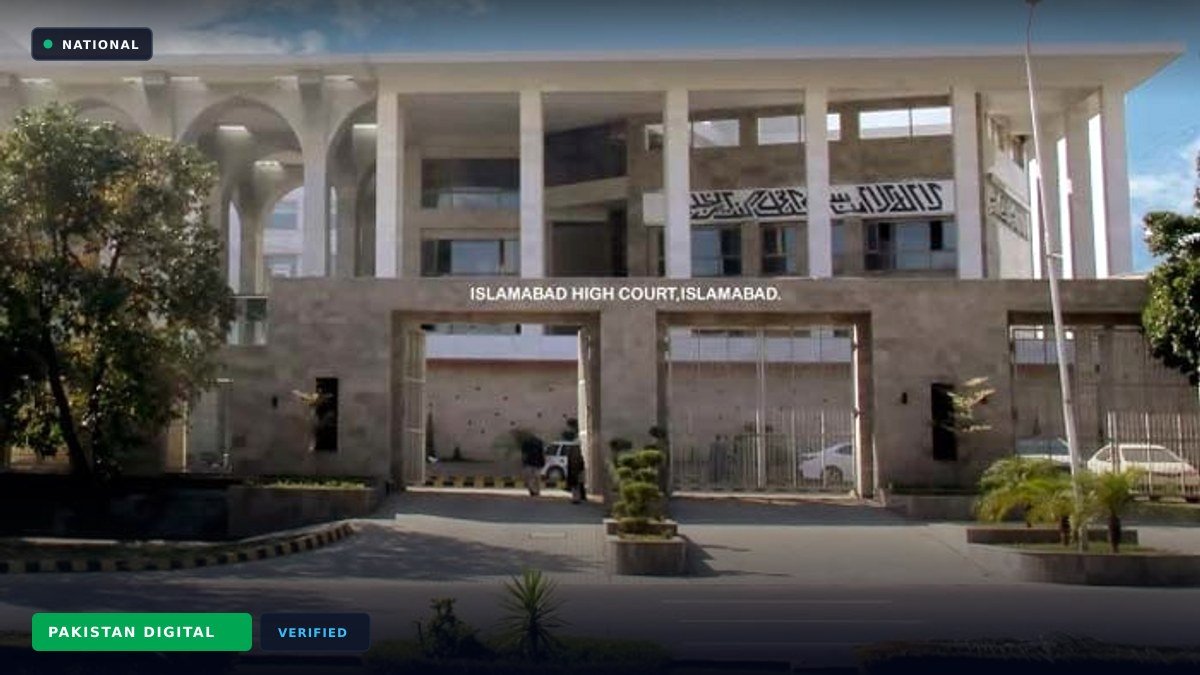
Islamabad has had no elected local government since February 2021. : Law requires ECP to hold local polls within 120 days of term expiry. : CEC accuses federal govt of seeking to sabotage Islamabad polls.
: ISLAMABAD: The Islamabad High Court (IHC) has suspended the local government election schedule in the federal capital by issuing a stay order against the Election Commission of Pakistan's (ECP) notification dated October 21.
IHC judge Justice Umair Majeed Malik announced a reserved verdict on a petition seeking to halt local government elections in the federal capital and suspend the election schedule.
The petition submitted by Amjad Ali contends that new delimitation was carried out in 2024, following which the election schedule was announced. However, a new Local Government Ordinance was introduced in 2026.
The petitioner's counsel contended that after the ordinance ceased to operate, the election schedule was issued without restoring the previous delimitation.
In its order, the court also issued a notice to the ECP and sought its response by November 26.
The term of the last elected local government system in the Islamabad Capital Territory (ICT) expired in February 2021, but owing to diverse legal and administrative reasons, fresh elections could not be held hitherto.
The statutory requirement under Section 219(4) of the Elections Act, 2017, is that the Election Commission is required to hold new local government elections within 120 days of the term’s expiration.
The development comes a day after Chief Election Commissioner (CEC) Sikandar Sultan Raja accused the federal government of trying to sabotage the upcoming local government polls in the federal capital and made it clear that the electoral exercise would be held as per schedule.
He made this accusation as he headed a three-member bench and heard the case of alleged violation of the code of conduct in the recent NA-77 by-election in Gujranwala, The News reported on Thursday.
He added that the federal government had ordered that teachers would not be assigned duty in the Islamabad local government elections. He wondered: “Where will the Election Commission bring staff from?
The Election Commission issues directions to the prime minister and the government; directions do not come from them to us.
” He took strict notice of the federal government’s order and charged that the federal government wanted to sabotage the Islamabad local government elections.
“I make it clear that the local government elections will be held in Islamabad,” he had observed.
The legal and procedural framework governing this matter underscores the critical importance of constitutional due process, judicial impartiality, and statutory compliance within Pakistan's judicial ecosystem.
Superior courts and competent adjudicating forums have continually held that administrative actions and prosecutorial requests must conform strictly to recognized standards of evidence, fair trial safeguards, and human rights benchmarks.
Legal practitioners and constitutional scholars point out that institutional adherence to statutory parameters remains essential to maintaining public confidence in the judicial process.
In addition to the immediate merits of the proceedings, judicial authorities emphasize that procedural integrity and transparent hearings are vital for safeguarding institutional decorum.
Relevant oversight bodies, bar associations, and statutory ombudsmen maintain rigorous vigilance over regulatory processes to guarantee that statutory safeguards are observed without arbitrary deviation.
Transparent judicial functioning is recognized by constitutional authorities as the bedrock of legal certainty and equitable public administration.
Legal analysts and senior advocates recommend that stakeholders and affected parties closely follow official court circulars, authenticated judicial transcripts, and certified case listings released through official registry desks.
Citizens and interested observers are advised against relying on unverified claims or circulating speculation on digital platforms, and are urged to verify case progress through official departmental bulletins and accredited legal counsel.